
What is a Good HRV: Heart Rate Variability Chart by Age
It is considered that higher HRV indicates better cardiovascular health and better integration between the parasympathetic and sympathetic nervous systems. The older you are, the lower your HRV is, so the conventional HRV chart by age looks like this:
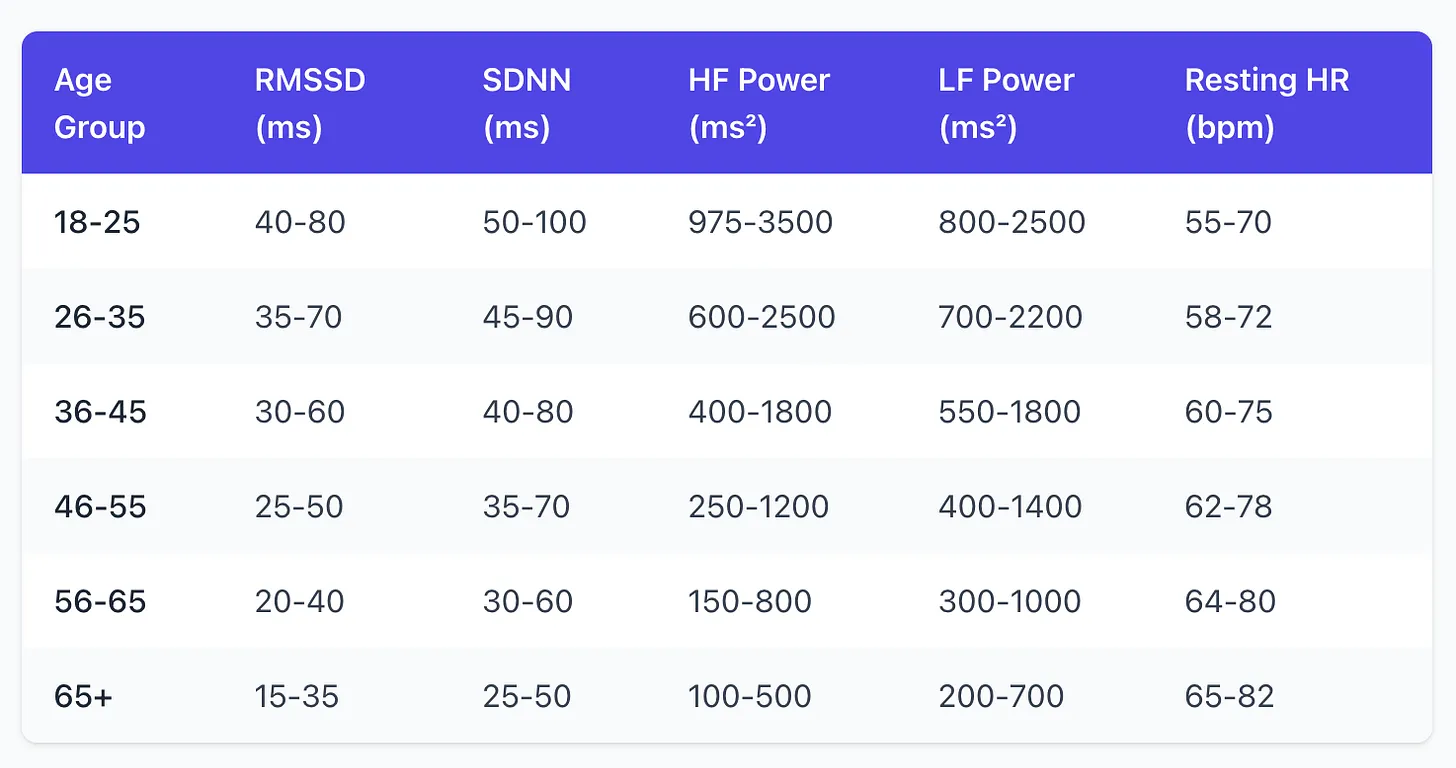
HRV values for healthy individuals. Optimal HRV chart by age for healthy adults at rest. Women usually have about 5ms lower HRV than men, especially when assessed using SDNN. Courtesy of SomaSync.
If you are a healthy adult of about 40 years old, your HRV will be at 30–60 ms when measured with RMSSD (the metric used by most fitness trackers and HRV apps) or at about 35–50 ms when assessed using SDNN, which is typical for continuous monitoring devices such as the Apple Watch. This would be when you're at the state of rest or sleeping. Women usually have slightly lower HRV than men (by about 5 ms). What this means is that your heart never beats in a steady rhythm, there are always small deviations between the beats.

How Does Heart Rate Variability Work?
How does it work? If your heart beats at 60 beats per minute, you won't have exactly 1000 ms between each beat. Instead, your RR (beat-to-beat) intervals might be 981, 1019, 1010, 999, and so on. This happens mainly because when you inhale your parasympathetic vagal activity is withdrawn, so the heart speeds up. When you exhale, your parasympathetic vagal activity is restored, so the heart slows down.
High variability indicates that your vagal brake is strong and responsive: you can shift gears quickly, responding to stress when needed but also recovering efficiently.
Understanding RMSSD
The 30 to 60 ms RMSSD range means that on average each beat differs from the next by about 30-60 ms. RMSSD (Root Mean Square of Successive Differences) is focused on the differences between the consecutive beats, so it is a cleaner marker of parasympathetic system's activity. For instance, a popular fitness tracker Oura Ring uses RMSSD to measure HRV during sleep. It takes 5-minute intervals and then shows you an average value of HRV (RMSSD) over these periods of time during the night as a chart.
Understanding SDNN
The SDNN (Standard Deviation of Normal-to-Normal intervals) measures the total spread of all your beat intervals around the average during the period measured. So the 40 to 80 ms healthy SDNN range captures the changes from all sources — parasympathetic, sympathetic (response to stress), circadian rhythms, and activities. That is also why SDNN will generally be slightly higher than RMSSD and indicates a general state of your body, rather than a snapshot at the moment of measurement. Apple Watch uses SDNN in its HRV reading and that's why it'll be sometimes slightly higher than HRV measured using RMSSD — it might be affected by light activity or a change of state.
How HRV Changes with Age
The younger and healthier you are, the more responsive your body will be to parasympathetic activity, which translates into higher HRV (in both SDNN and RMSSD). HRV will also be higher when you are resting or sleeping. While the standard range for a 40-year old male is 30 to 60 ms, it could easily double during sleep, prolonged rest, or as a result of regular, but not excessively straining, physical activity.
As you get older (or sicker), your HRV decreases, so for a 65+ year old person this difference decreases to 15-35 ms RMSSD and 25-50 ms SDNN. So what does it tell us about your health?